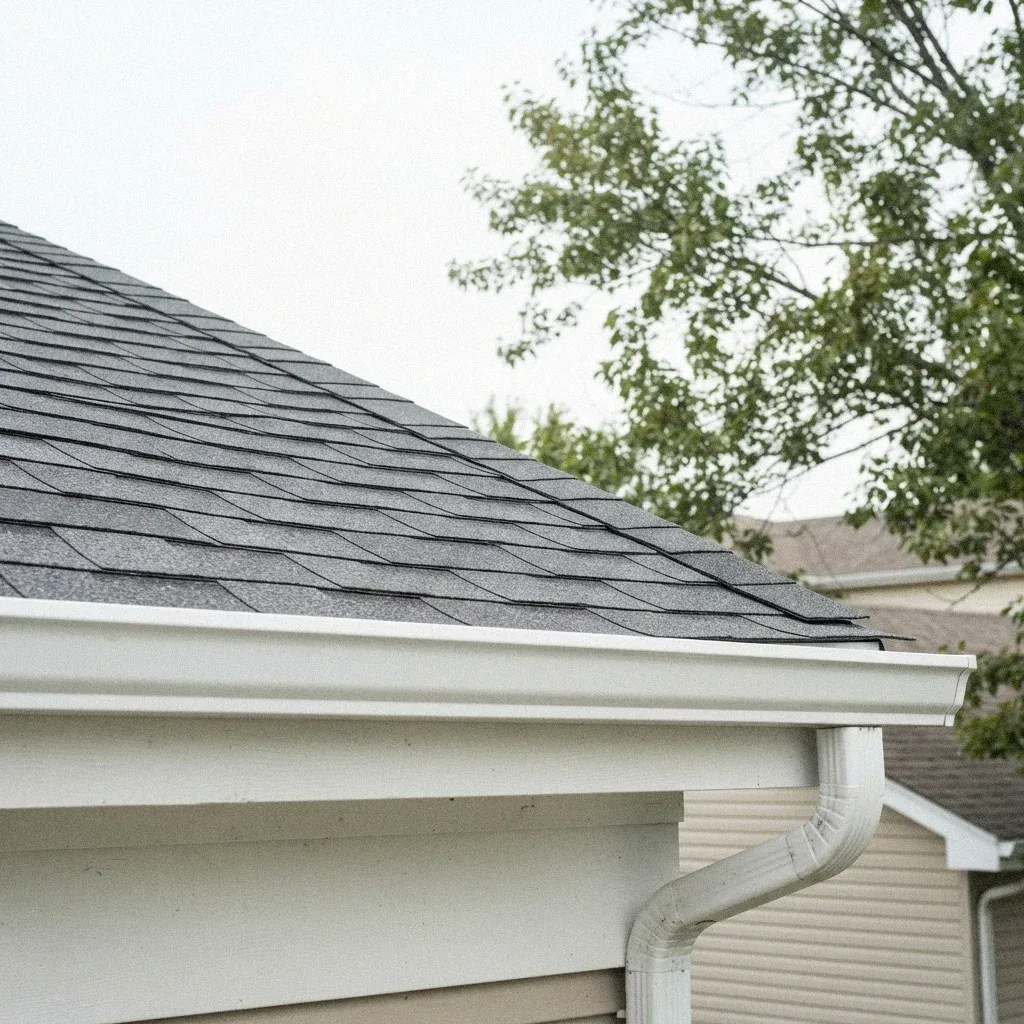
Making Sure Gutters Actually Move Jacksonville Rain
Gutter sizing, downspout counts, slope, and hardware built for Jacksonville's heavy summer downpours.
A properly drained Jacksonville roof needs enough downspouts to keep runs under about 35 feet, quarter-inch-per-ten-foot slope, hidden hangers every 24 to 36 inches, sound fascia, and drip edge that actually feeds the trough instead of the wall.
Choosing the Right Gutter Profile
A gutter run does one job that matters in Jacksonville: it gets rainfall off the roof and away from the slab before the sandy soil around the foundation turns to mud. Afternoon thunderstorms here can drop an inch in under an hour, and a roof edge with nowhere to route that volume just dumps it straight down along the wall. Neighborhoods from Riverside to Arlington deal with this every summer.
Five parts have to work together for that to happen: the gutter catching water off the shingle edge, the channel carrying it to a corner, the downspout dropping it to grade, the discharge point moving it clear of the house, and the hangers holding the whole run level enough to drain. Skip one and the others cannot make up for it, no matter how new the aluminum looks.
Most Jacksonville homeowners only notice drainage when it fails — water sheeting off a corner, a soaked flower bed under Ortega oak canopy, or a soggy patch by the driveway after every storm. The fix is rarely a single broken piece. It is usually a mismatch somewhere between how much water the roof sheds and how much the system was ever built to carry, and that mismatch shows up worst during hurricane season.
How Many Downspouts a Roof Needs
K-style gutter dominates Jacksonville rooflines because its flat back sits flush against fascia and its front profile looks like crown molding from the ground. Half-round gutter shows up on older homes in Springfield and Avondale where the original trim called for a rounder line, and it sheds leaf debris a bit more easily since there's no flat ledge for it to catch on. Both come in five-inch and six-inch depths.
Depth decides capacity. A five-inch profile handles a typical single-story roof plane fine, but a steep gable or a large connected roof area — the kind common on bigger homes in Mandarin or San Marco — pushes more water to fewer feet of gutter, and six-inch stock buys the extra margin. The downspout has to scale with it, or the wider trough just backs up at a narrow exit.
- Five-inch gutter suits most single-story roof planes; a large or steep roof pushing more water to less edge wants six-inch stock and a matching downspout.
- Hidden hangers set every twenty-four to thirty-six inches into the fascia board keep the run from sagging once summer downpours fill the trough.
- Fascia board condition determines whether hangers hold; soft or rotted fascia from years of overflow won't grip screws driven into rafter tails.
- Slope of about a quarter inch per ten feet toward the outlet is enough to drain and small enough to lose to one sagging hanger.
- Kickout flashing at a roof-to-sidewall junction near a gutter end keeps runoff off the fascia and wall assembly.
- Kickout flashing at a wall-to-roof junction, like a dormer or porch tie-in, diverts water into the gutter instead of down the siding.
Pitch, Hangers, and Fascia Support
How many downspouts a house needs depends on how the roof breaks into planes, not on square footage alone. A long, unbroken run over a Northside ranch might work fine with one downspout at each end, while a home with valleys and multiple gables, common in Ortega Forest and San Jose, needs a downspout near every low point so water never has to travel far sideways during a downpour.
The outlet, where the trough necks down into the downspout, is where debris jams first. Pine straw and oak leaves from mature Riverside and Avondale street trees settle there because the opening is smaller than the channel feeding it. Once that choke point clogs, the whole run backs up behind it even if every other foot of gutter is clear and pitched correctly.
- Downspout extensions carry discharge a few feet past the slab edge using a hinged piece, a splash block, or a rigid section.
- Underground drain lines route downspout water into a buried pipe that carries it further from the house before it surfaces.
- Overflow at a run's high point traces back to too few downspouts, a clogged outlet, or a sagging low spot in the gutter.
- In low-lying stretches near Pottsburg Creek or Hogans Creek, an underground drain line should daylight well past the yard, not at the property line.
Seamless Gutters Versus Sectional Runs
Pitch is the built-in tilt inside a gutter run that pushes water toward the outlet instead of letting it sit. On a typical Jacksonville roofline the drop is small, often just a fraction of an inch per section, but it has to be continuous. A sagging hanger or a section nailed level breaks that tilt, and standing water finds the nearest low spot to spill over, usually right where a downspout should be catching it.
Hidden hangers, spaced roughly every two to three feet along the fascia board, carry the load of standing water plus whatever debris settles before a cleaning. Wider spacing saves material cost but lets the front lip sag between brackets, which throws off the pitch calculated when the run was hung. A gutter that looked correctly sloped at installation can develop low spots within a few storm seasons if hangers were stretched too far apart.
| Hardware | Where It Goes | What It Solves |
|---|---|---|
| Number of joints along a run | None between corners and outlets | One every ten feet, roughly |
| Where leaks tend to start | Almost never along a straight run | At the joints first |
| How it gets made | Formed on a truck at the house | Pre-cut lengths joined on site |
| Fix for a dented section | Cut out and replace that stretch | Unscrew and swap the single piece |
| Where each type shows up most | Most homes going up or reroofing now | Older homes and DIY gutter kits |
What an Undersized System Looks Like
Seamless gutter is extruded on-site to match each fascia run exactly, leaving joints only at corners and outlets instead of every ten feet like factory sectional stock. Fewer joints means fewer places for a seam to open under thermal movement between a hot Jacksonville afternoon and an overnight cooldown. Sectional gutter still shows up on older homes in Murray Hill and Lake Shore where original trim was never replaced.
Hidden hangers carry the actual weight of a full gutter, and they anchor into the fascia board, which in turn ties back to the rafter tails. If that fascia board has softened from years of water sitting against it, screws stop holding and the run pulls away from the roof edge under load. Kickout flashing matters here too, since it steers roof runoff at a wall intersection into the gutter instead of behind it and down the siding.
Keeping the System Working Through Summer
Drip edge sits under the shingle and over the gutter's back lip, and if it was installed too far back or bent the wrong way, water follows the underside of the shingle past the gutter entirely instead of dropping into it. This shows up as staining on the fascia board below a gutter that otherwise looks fine, and it is a common find on reroofs across Cedar Hills and Englewood where the original drip edge was never corrected.
Once water leaves the downspout, a splash block or downspout extension has to carry it several feet past the wall, and on lots that slope toward the house — not uncommon near creek-adjacent streets by Pottsburg Creek or Fishweir Creek — an underground drain line routed to daylight further out does more good than a short extension dropping water right back against the slab.
When Fascia and Hangers Fail
- Five-inch K-style gutter fits most Jacksonville rooflines; six-inch profile suits steep or larger roof planes and heavy summer rain volume.
- A downspout roughly every thirty-five feet of run keeps water from having to travel far sideways during a Jacksonville downpour.
- Downspout extensions and buried drain lines move water away from the slab, which matters most where sandy soil drains fast but sits close to the house.
- The outlet where the trough necks into the downspout jams first, because it is narrower than the channel feeding it.
- A downspout extension or underground drain line should carry water well clear of the slab, not just off the edge of the roof.
- Drip edge has to sit over the gutter's back lip, or water tracks behind the trough and stains the fascia instead.
Frequently Asked Questions
What size gutters do I actually need?
Water spilling out during a heavy Jacksonville downpour points to one of a few causes: the gutter is too small for the roof area feeding it, the pitch has flattened or reversed somewhere along the run, or the outlet is blocked and backing up. Afternoon thunderstorms in summer push a lot of water fast, so a system that's marginal on a light rain will show its limits the moment a real storm rolls through.
How many downspouts should my roof have?
Jacksonville's afternoon thunderstorms can dump a lot of water fast, so most single-story homes need a downspout roughly every 35 feet of gutter run, with an extra outlet added wherever two roof planes dump into one trough, like at a valley near Riverside or San Marco.
What's the difference between seamless and sectional gutter?
Where the joints are. Sectional gutter comes in pre-cut lengths joined every ten feet or so, and each of those joints is sealed by hand. Seamless gutter is rolled out of a machine on a truck at your house to the exact length of the run, so the only joints are at corners and outlets. Since almost every gutter leak starts at a joint rather than in the middle of a straight run, fewer joints is the whole argument. Sectional still turns up on older Murray Hill and Lake Shore homes.
Should I switch to seamless gutters?
A gutter overflows when the pitch is too flat, an outlet is undersized, or a downspout extension dumps water back against the fascia board instead of carrying it away. Heavy oak and pine canopy in Ortega and San Jose also drops enough debris between cleanings to choke a trough mid-storm, even one sized correctly for the roof plane.
Where should downspout water actually go?
Extend the downspout discharge, by splash block or buried line, so water lands well past the slab edge and doesn't pool against the house. On Westside and Northside lots with sandy soil, water sitting near the foundation soaks in fast but still needs to move.
Ready to Size Your Gutters Right?
Talk with the licensed pros we connect you with about sizing or fixing a Jacksonville home's gutter and drainage system.
Call (904) 675-6349